25 March 2009

Gogo Para Presidente

OK, does anyone else remember this? I've been searching the internet for this clip for, like, the last 5 years, and today I finally found it! All I have to say is, "vote Goat."

18 March 2009

Fear in a Handful of Dust

Ok, I just sort of realized that for the last couple of weeks, I've had all these lines from Eliot rolling around in my brain.  And I don't know what it all means.  I mean, I know what the individual lines mean, or at least I think I do.  But I don't know why I've been sort of non-consciously meditating on Eliot.  And it seems like maybe it is significant that here I am, a week before my birthday, contemplating Eliot's "handful of dust."  Anyhow, it seems like maybe I should throw out there the lines that have been popping in and out of my awareness.  And I should maybe preface this all by saying that I've been reading Dante pretty intensely lately; Eliot is certainly interested in Dante.

So clearly, "I will show you fear in a handful of dust" is striking a chord with me.  And as I've been walking around, breathing in and out, going to class, whatever, I find myself repeating over and over, "I will show you fear in a handful of dust.  I will show you fear in a handful of dust."  When I finally stopped and thought about it, I realized that this was a line from The Wasteland.  So here's the line in context:

And I will show you something different from either
Your shadow at morning striding behind you
Or your shadow at evening rising to meet you;
I will show you fear in a handful of dust.

So here I am, the week before my thirth-fourth birthday, thinking not about youth, the shadow at morning, nor old age, the shadow at evening, but death, that "handful of dust."  That makes it sound like I'm all depressed; I don't think that I am.  And yet, mortality is on my mind.  It's like a refrain in and out of days and over the weeks and through the years, this "fear in a handful of dust."  And yet, I'm believing more and more that death is but a "sea change."  Doesn't Eliot quote "those are pearls that were his eyes" in The Wasteland?

The other line, this one from Prufrock, that keeps playing in my head is the one about preparing "a face to meet the faces that you meet."  And I do so often think about all the energy, really, that I spend preparing that face; that is, I spend too much effort trying to present myself to the world in such a way as to demonstrate that everything is OK, trying to convince everyone (and maybe myself) that I'm just fine, that I'm getting through.  And I am getting through.  But so often, it's painful.  And just prepaing that face is hard some days.

I'm certainly no Eliot scholar, but I am finding myself drawn to Eliot.  And I've spent much of the afternoon reading and rereading The Wasteland, and Ash Wednesday, and the Four Quartets.  Eliot makes me want to pick up my John Donne.

02 March 2009

Update

It just dawned on me that I've not posted anything in quite a while.  I'm going to avoid the post about why I've not posted and, instead, try to give a quick round-up of what's cookin' in my world.  At the moment, my linner, a spinich artichoke heart calzone, is cookin' thus limiting my post to about 15-minutes worth of ramble.  I feel like I've been working a lot, in a good way.  I've been preoccupied with things like Dante, Beowulf, and The Lion, the Witch and the Wardrobe, which is a not-at-all bad combination.  I've also been reading quite a lot.  The week of 16 February, we had winter break, so I spent the week reading and watching DVDs and cooking, quite a lovely way to spend break.  Oh, I made this divine cheddar beer soup!  It's one of the best things I've ever tasted.  Seriously.  Yesterday, I had lunch at Cafe Provence, where I ate scallops wrapped in smoked salmon.  It's possibly the single most wonderful thing I've ever tasted.  I've read a couple of PD James novels lately; I'm in the middle of her Unsuitable Job for a Woman just now, and it's quite good.  I also read something--13 Stairs?  13 Steps?--by Ruth Rendell; it was quite disappointing.  I also read Rosalind Miles's Guenevere Queen of the Summer Country.  It was sorta too Mists of Avalon.  (Side Note:  I really want to like Marion Zimmer Bradley, but I just don't!).  More interesting are the DVDs I've been watching.  I watched the first two seasons / series of Helen Mirren in Prime Suspect--wonderful!  This is just the sort of British who-done-it that appeals to me.  And how can one not like Dame Helen?  Also, I've discovered Battlestar Galactica, thanks to A., a much appreciated colleague.  And it's totally kick-ass.  Seriously.  I probably watched a good 10 hours of it over the weekend.  Totally recommend.  The plot's interesting and not entirely predictable, and there's interesting character development.  I've also sprinkled in episodes of Upstairs, Downstairs, As Time Goes By, and *gasp* Gossip Girl.  I'm not sure if I can really do Gossip Girl or not.  I watched the first four episodes from Netflix and was entertained enough to order the next disk.  But really, there's a limit to how much disbelief I can suspend when it comes to NYC teens.  I mean, 90210 is soooooooooooo much more believable.  So that's pretty much it for me:  food, books, and DVDs.  I'm sparing you the narratives about students texting in class and not reading Beowulf. 

Oh yeah, on 15 February, P. and I saw Willie Nelson in Albany NY with Asleep at the Wheel.  I LOVE Willie.  Love him.

07 February 2009

I've Been Tagged

Ok, I was "tagged" by Cheri.  I'm supposed to post the forth picture in the forth folder in my photo program--I use Photoshop--without editing it.  So here it is.  I took this not too long after I moved to Vermont a a local cemetery.  I have this thing for graveyard photos. 

So it just sorta dawned on me that I haven't posted anything in a couple of weeks.  That's not because nothing's been happening--it's more that I've been totally preoccupied with work for the last three weeks.  And that's not all bad.  So as part of our first-year student program, we assign a common reading assignment for all first-year students to do over the summer (we're not supposed to call them Freshmen anymore, in case you are wondering).  So I'd volunteered to be on the committee to choose the reading for this summer.  Hey, I read; I review books; I work with literaure.  This seemed to make sense.  Additionally, I'm one of many faculty members who will have to work with the students using the book in question.  So I'm not sure where the various nominations came from--mostly from other faculty members, I think.  Anyway, I was assigned to read three books in order to give my opinion, input, whatever.  Well, I felt like the proverbial stick in the mud, because I absolutely hated all three. 

First, we had Three Cups of Tea.  This was the work that originally I was most excited about.  It's the account of one man, Greg Mortensen, who has built a number of schools, particularly for females, in Pakistan.  I'd heared Mortensen on NPR, and his story is interesting and inspiring.  In many ways, he's simply an ordinary man who has accomplished remarkable things.  Well, I just hated the book.  It's written by a ghost writer, not Mortensen himself, and it's just not very well written.  I'd much preferred to hear Mortensen's own story, first-hand, in the first person.  But what really bugged me--and apparently noone else on the committee sees it this way--is that the work feels like it's just trying too hard to be inpsirational.  I hate that.  I've realized through this process that too often what other people perceive as deep and meaningful and moving, I just see as contrived and maudline.  I like a well-told story, and I like when it's a poingnant story, but don't hit me over the head with how meaningful and deep it's all supposed to be.  I mean, it seems to me that NPR's This American Life does this great job of simply telling a story and allowing the meaningful, inspirational bits to emerge, or not.  That's what I want.  I recently saw Garrison Keillor--he does that kind of thing well too.

Next, I was supposed to read Randy Pausch's The Last Lecture.  This one I'd also heard about on NPR.  Apparently, it's the hot thing to read in some circles right now.  Basically, Pausch is dying (of cancer, I think) and he gives a lecure or series of lectures in which he reflects on his life, on following one's dreams, that kind of thing.  This work is adapted from his lectures.  Apparently, you can see Pausch on YouTube, if you are so inclined.  Again, there's something overly sentimental about the dying guy giving us his last reflections.  I feel bad writing this, which illustrated part of my objection about this book, at least for our FYS program:  I mean, it's really hard to have a critical conversation about the ideas of the dead guy, you know?  We all feel bad that this man had to die in the prime of life, that his wife and children are living without him--this is sad, and we feel for these people.  And that makes it really difficult to say that we find what he has to say irrelevant or frivilous or just plain wrong.  We're reluctant to be critical about the dead guy.  I might also add that, again, this feels like a work that being inspirational in a way that's just too much--even the format of the book screams, "Hey, here's a work that'll move you." 

I was also assigned to read Loung Ung's First They Killed My Father: A Daughter of Cambodia Remembers.  This, as the title would suggest,  is a kind of memoir by a young woman, a refugee from Cambodia, who lost many, many family members.  Come to think of it, I've also heard Ung on NPR, talking about another book of hers.  This one was written entirely in present tense, which kinda annoyed me.  I honestly didn't read much of it, as it simply felt too depressing.  I mean, I tend to be depressed anyway, and it just felt like whatever payoff I'd get wasn't worth the depression it seemed to be feeding, you know?  Again, I'm sure that Ung has an absolutely remarkable and maybe even inspiring story to tell.  But it just didn't feel appropriate for our program.

OK, so on Wednesday, the committee met to choose a book.  I was pleased to discover that I wasn't the only one who really didn't feel enthused about any of the options--and there were others on the table.  The three listed above are just the three that I happened to be working with.  Many of my colleagues did like Three Cups of Tea, and I think that it got more positive feedback than any of the others.  But ultimately, we decided that we'd like to consider more options.  This is good in that I thought all the options were pretty crappy; this is bad in that it means more reading of things I might not really want to read (see below.)  I promptly suggested anything by Jon Krakauer, preferably Into Thin Air, which I absolutely love.  I also suggested Gregory Maguire's Wicked, another favorite of mine.  I've used both successfully with first-year students, I should add.  (Side bar:  OK, Cheri, I know you thought Wicked was disturbing, and it is.  I think it's supposed to be.  But I still think it's really, really wonderful, though not at all like the musical.)

Anyhow (this is turning into a long post!), many on the committee also thought that Daniel Quinn's Ishmael was a good option for our program.  I'd never read it before, but it is a work that you see all the time on lists of life-changing works.  Honestly, I'd been avoiding Ishmael for the last 10 years or so.  I've known of colleagues who use it in class, often with Zen and the Art of Motorcycle Maintainence, and somehow I've had the impression that both are works that appeal to former hippies and maybe not the rest of us.  But the dean was saying that students find Ishmael really moving and all that, so I decided that it was time to read it.  So here's my quickie overview:  it's written much like a Platonic dialogue.  You have the student and the teacher talking back and forth, asking and answering questions about philosophical matters.  There's very, very little plot and lots of talk about ideas.  I don't necessarily love this set-up--I find it rather tedious (I'd rather just read an essay) but it could have been OK.  What really killed it for me is this:  the teacher-figure is a 500-pound, thinking, telepathic gorilla.  Apparently, when he was younger he learned to understand English, tried to learn to speak but doesn't have the necessarly apparatus.  So he learns to communicate telepathically.  I'm not making this up, but it sounds ridiculous, I know.  In fact, as a way to frame the story, the discussion it IS ridiculous.  I just couldn't take it seriously.  Really.  And as the book progressed, I kept thinking that there would be this big revleation at the end, something that would really hit me, you know?  And yes, there were big ideas, possibly life-changing ideas, that come up, but none of it felt particularly fresh, or insightful, or new, or even all that compelling to me.  Again, maybe I just can't swallow the whole telepathic gorilla, Ishmael, sending us all brainwaves to communicated his profound insights.  Annoying.  The work was only published in 1992, but it felt oddly dated to me.  I cannot, in good conscience, support this as something we compell our incoming students to read.

I don't know where to go from here--can't we all read Umberto Eco or C.S. Lewis and be done with it?  All this, combined with students who keep saying that they just don't "get" The Wind in the Willows, has made it a frustrating week.  I totally feel like I need some make-up therapy or to at least indulge in a book that I actually like.

24 January 2009

Buh-Bye DirecTV

OK, I've decided that I''m getting rid of television.  I'll keep my two TVs, and I'll watch DVDs, but no more satellite TV for me.  Before I go further, I should say that I really do love DirecTV.  I love watching the cable news channels and USA and TNT and the Food Network and ID, which is new-ish.  Anyway, I love it.  But I've come to the conclusion that I'm watching more TV than can possibly be good for me.  It's not a good sign that I know, every single day, what's transpired in the Caylee Anthony case.  It's not a good sign that I sleep with the TV going all night.  It's not a good sign that I know what's on Bravo almost every night.  Also, I have to give a shout out to the customer service people at DirecTV.  Seriously.  When I've had questions, which isn't often, I've always been amazed at how helpful they are.  And it appears that they've not outsourced calls to techs in another country.  I hope this isn't too un-PC of me, but I hate it when you call and 800 number and get someone who just doesn't speak English very well. 

Anyway, I've been thinking, for quite some time really, that I'm simply watching too much of what I call "default TV."  That's when I turn on the television and zone out in front of something I don't necessarily really, really want to watch but it's just what's on.  And I feel like I am just wasting too much time, time that could be spent reading or writing or crafting or relaxing in a more productive way (read: yoga, bubble baths, and meditation practice).  I mean, I think that I'll be a happier, healthier person without TV there to distract me.  Oh yeah, I've also fallen into the habit of just having the TV running in the background all the time when I'm at home.  So I feel like getting rid of TV will free up my time and attention (not to mention my finances) for other more productive or more bliss-producing activities.

Finally, I just feel like I need some changes in my life.  I feel like I keep working and working and working on somehow getting my life in order, getting my life on track.  And believe me, it often feels like it's dramatically, inexplicably derailed.  When I feel like this, it always seems like some big change shakes things up and helps make the adjustments I'm looking for.  This is a much larger issue with me, larger than whether or not to watch TV.  It's just that every week, almost every day, I feel like I can never get enough done.  If I manage to stay on top of it all at work, which I often do, it seems like my house is a total disaster.  If I'm really disciplined about one thing, say what I'm eating, I can't seem to be at all disciplined about another.  It's so frustrating.  And I keep trying and trying to be better about it all, but I'm not sure I've made much progress in the last five years (or maybe ever!).  Anyway, I know that many of you may not understand, but getting rid of TV feels like a way to move towards getting my life and myself in order.

Not to fear:  I am keeping Netflix!

20 January 2009

First Day

So today, inaguration day, is the first day of the new semester for me.  First day of classes is always, always kinda boring--going over syllabi, learning students' names.  But starting a new semester always feels good, like a fresh start.  It's a time to reassess and set goals and all that kind of thing.  One of my goals is to spend more time prepping for class (but not more time grading!).  I so enjoy the prep work when I set aside the time to do it properly. 

Well, I'm off to 20th Century Children's Lit!

16 January 2009

Mama Said There'll Be Days Like This

So you know those days when nothing disasterous happens but it still feels like every little thing goes wrong?  In spite of a couple BIG reliefs, it's been one of those days.  After several nights of insomnia, I slept really well last night and woke up a little before eight.  But there was no water coming out of any of the taps--I was certain my pipes had frozen, although I had left the heat running last night.  I called my heater guys.  Well, it turns out the pipes hadn't frozen--it was no big deal.  But it was still really stressful.  At that point, I decided I'd go into campus for a couple hours.  I intended to wear my snow boots, but about half way there, I realized I was wearing these old Birkenstock clogs.  I've had them for about 13 years, and the sole is all worn down--not good for walking across the icy parking lot.  Also, I forgot to take my lunch with me.  Once I got to work, I got an e-mail from the bookstore that one of the books I'd ordered was unavaliable; it was out of stock at the publisher.  This would be no big deal except that classes start Tuesday.  This was all especially annoying because moths ago when I picked books, I had all kinds of confusion over the particular edition / translation.  The publisher's materials were incorrect, and it was a big pain just figuring out which translation was the one I really wanted.  Oh, and I'm having cramps, so I feel just generally icky physically.  And I have, like, zero appetite, which isn't necessarily bad--just weird.  Anyway, although I'm so thankful that my water pipes didn't freeze (and subsequently burst!), it's still been one of those days.

10 January 2009

Diana Wynne Jones

I've just started reading Diana Wynne Jones's The Magicians of Caprona.  And it's quite delightful.  In my expert opinion (ha, ha--I just love saying that), Jones is possibly the most underrated contempporary writer of juvenile and YA fiction.  I have not read anything by her that I haven't liked.  I think that Charmed Life, which I reread over the Thanksgiving holiday, is maybe my favorite.  Especially in her Chrestomanci collection, of which both Charmed Life and Caprona are a part, Jones does some really interesting things with how her fantasy world works and how it may be related to the world you and I know.  I particularly enjoy fantasy in which you and I, as readers, are "Otherized" (if I can use that word) by the characters and the social structure of the fantasy world.  Here's one of my favorite examples of what I mean:  In Lewis's The Lion, the Witch and the Wardrobe, Lucy puruses the books on Mr. Tumnus' shelf.  The titles include things like Man:  Myth or Reality and other titles that would suggest that in Narnia humans are mythical creatures of the fairie realm, much as we might think of elves and satyrs.  (I don't have the title of Tumnus' book quite right, I'm sure, and my coies of TLWW are all in my office at work, so I can't look it up just now.)  But you get the point:  we are made to feel Other, foreign, outsiders, strange, even disenfranchised in some way.  I don't know why, but I find fantasy that constructs the reader this way as particularly interesting, enjoyable fantasy.  And there are certainly moments when Jones does this quite well.  In all sincerity, I hope that this concept makes its way into a conference paper or something of that sort sometime soon in my professional life.

09 January 2009

New Alarm Clock

You may remember that about six weeks ago, I had an alarm clock emergency.  Well, yesterday, I got home and had a package from UPS.  My brother had ordered me this alarm clock as an early Valentine's Day gift.  Isn't it too, too cute?  I absolutely adore it.  It's perfect for my soon-to-be pink bedroom.

08 January 2009

New Blog!

Ok gang, I've started a second blog--one devoted to makeup, style, that sort of thing.  It's still in the fledgling stages, of course, and it may be a rather short lived project.  But if you are interested, read Airing My Dirty Laundry.

07 January 2009

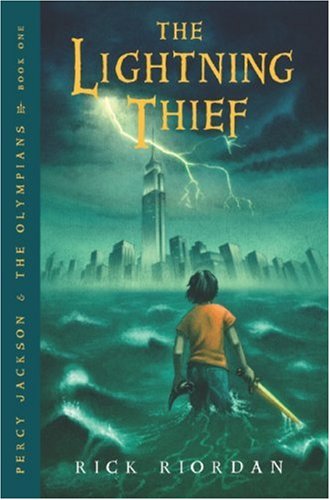
The Lightening Thief by Rick Riordan

Ok, so I really enjoy juvenile and YA novels, especially fantasy.  It used to be my guilty pleasure / guilty secret.  But now that I have a job that warrants reading all this sort of thing, I can feel somehow justified.  But let's face it:  I just really enjoy this sort of thing.  Recenly, my brother John recommended Rick Riordan's Percy Jackson and the Olympians series, and last week I picked up the first in the series.  It was actually much better than I'd anticipated.  At first, I was just annoyed by the protagonist--I found Percy to be whiney and not at all likeable.  But as the novel progresses, and as Percy endertakes a quest of heroic proportions, he grows and develops in such a way that he becomes likeable and sympathetic.  So here's the quick summary:  12-year-old Percy Jackson, who lives in contemporary America, discovers that his father is one of the classical gods.  Olympus has somehow been relocated to the top of the Empire State Building.  And Percy must undertake a quest to recover Zeus's lightening bolt of power.  Riordan uses classical characters and themes in creative, interesting, and not entirely predictable ways.  In all, it was a good read.  John basically told me that it's clearly written for eighth  or nineth graders, so it reads really quickly but that it's both entertaining and interesting.  And he's right.  That pretty much covers it.  Next in the series is Sea of Monsters, and I hope to read it soon.

Better-Than-Kraft Mac & Cheese

Ok, so I call this Better-Than-Kraft Macaroni and Cheese.  It's super easy, super yummy, and probably really bad for my waistline.  I make it a little differently each time, depending on what I have in the fridge, but the following, for two servings, gives the basic idea.  It certainly takes no more time than good ol' Kraft.

1.  Bring to a boil enough salted water for aproximately 2 cups penne or elbow macaroni.  Cook according to package directions.

2.  Meanwhile, in a 2 quart sauce pan, melt 3 Tablespoons butter.  Stir in about 2 Tablespoons cornstarch.  I used to use flour, but Zee suggested corn starch, and it gives a better texture than flour.

3.  At this point, you should have a quick-y roux in the pot.  Stir in about 1/2 cup milk (1% is fine).  "I see you're drinking 1%. Is that 'cause you think you're fat? 'Cause you're not. You could be drinking whole if you wanted to."

Now here's where things get fun because there are lots of options.

4.  I like to add about 2 to 3 Tablespoons sour cream at this point, but this is optional.

5.  Stir in a couple dashes of Worchestershire sauce, a bit of garlic salt, about 1/2 teaspoon dried mustard, and a tiny dash of Tobasco sauce or cayanne pepper.  The Tobasco or cayanne doesn't make it spicy, just gives it a kick.  These seasonings are really to taste, and I don't measure.

6.  Stir in about 1 cup of shredded cheese.  I like to use a combination, with sharp cheddar forming the majority of the cup.  I've also used Cabot horserasish cheese, and it's super.  But I like to throw in a little something else, if I have it.  Today, I added just a tiny bit of this Double gloucester / stilton blend I had in the fridge.  I've used a cheddar / jack blend with taco seasonings already mixed in, and that's good too.  Feta, I've discovered, doesn't melt very well.  I tend to buy the pre-shredded stuff to save time.

7.  The heat should be really low on the cheese sauce, and you need to stir it pretty frequently until everything melts and the consistency is smooth.  I heat it until it just starts to bubble, then turn it as low as possible.

8.  In just a few minutes, the pasta should be done.  Remove it from the heat and drain it.

9.  At this point you have two options.  You can either add the drained pasta to the pot of cheese sauce and fold it in.  Or, if you are Zee, you can put the pasta in your bowl and ladel the cheese sauce on top.

That's it!  Super simple, and super tasty.  The sour cream is optional, but tastes good.  You can even skip the milk and stir the cheese right into the butter / corn starch roux.  I've even skipped the corn starch completely, and that's fine too.

It's yummy with Durkee french friend onions (you know, the ones in a can) sprinkled on top.

This is seriously my new favorite comfort food, and I eat it at least once a week.

06 January 2009

31 December 2008

2009--The Year of Dante

So I've decided that 2009 shall be my year of Dante's Divine Comedy.  Or at least, January through May will be devoted to Dante.  Over the past couple of days, I've been reading various introductions and background-type essays.  But this morning, I sat down and read Canto I of the Inferno in a couple of different translantions (Sayers and the Hollanders) and then read all kinds of commentary and notes just on that first Canto.  And I've read Dante before, but I feel like for the first time I'm not just studying Dante but am really understanding Dante.  It's not that I'm just getting it intellectually; it's more that I feel like the whole thing is actually speaking to me, you know?, on many levels at once:  imaginative, emotional, spiritual.  And it seems to me, right now anyway, that that's the whole thing about Dante.  Yes, it's allegory, but it's more than "just" allegory.  It operates at the literal level, but it's operating at all these different levels of human experience all at the same time.  And none of these levels or meanings is exclusive of the others; rather, each informs the others and enriches the others.  I know that what I'm getting at is maybe obvious--it's what I've known intellectually about Dante all the time.  But I feel like for the first time I'm experiencing it, rather than just understanding how it's supposed to work.  And I marvel at the skill of it all.  I'm not just understanding, but I'm being moved, changed.

But really, what's motivated this particular look at Dante is that I'm teaching Dante next semester.  And as I've been reading about Dante and thinking about Dante and finally reading Dante's work, all I think, in reference to the course, is, "How are my students going to deal with this?  How are they going to respond?"  More specifically, I'm concerned that they might not respond at all, that they might just shut down.  Reading Dante is no easy task.  And I'm afraid that the room will be filled with apathetic students who don't really know how to work at this task.  The translators and commentators I've been exploring seem to agree that reading Dante requires participation and work on our part, and in my experience, many of my students just seem interested in a passive reading experience, if they are willing to read at all.

But really more significant, I think, that the necessity of our being active readers is that Dante's way of thinking about the world is simply so alien to so much of postmodernity.  Dorothy Sayers says, "We must also be prepared, while we are reading Dante, to accept the Christian and Catholic view of ourselves as responsible rational beings. . .The Divine Comedy is precisely the drama of the soul's choice."  This way of thinking about the self and the world seems to me to be so foreign to much of our culture.  In Dante's world, sin matters; it enslaves us in the present world and for all eternity.  As a culture, we can think in terms of sex addiction, but most of us don't really buy the idea that lust, one of the seven deadly sins, can destroy our soul.  I, for one, am willing accept Dante's general scheme of things; the choices we make do matter, and maybe what matters the most is how our inner selves are affected.  Sin and evil do exist.  But in a world where absolutes are eschewed and a notion of the soul is thought of as simply out dated, what place does Dante have?  And how can I convey to my students that these questions matter, or that at least to make sense of Dante, we have to suspend our disbelief?  I'm feeling so inadequate to the task at hand.

But Dante.  He's like my Beatrice, at least for the moment, a bright ray of light, leading the way to some sort of Truth.

30 December 2008

Martha and Conan

I've been meaning to post this for a while; it's too funny.

29 December 2008

The Contemporary Freak Show

For some reason, I've always been interested in the "old school," P.T. Barnum-style side show.  In fact, I really like the term "freak show," probably because I've always been morbidly fascinated by the 1930s film Freaks, which you, dear reader, should see if you've not already.  But for better or worse, in our society, we seem to have decided that the freak show is no longer socially acceptable.  And I do think this cultural movement is for the better:  I cannot really at all justify the all-too-human tendancy to objectify and gawk at the disabled.  And this is what the freak show (as opposed to the "geeks" in the sideshow) is really about.

Lately, I've found myself watching the Discovery Channel and its sister channels Discovery Health and The Learning Channel a little too frequently.  The line-up includes such favorites as Jon and Kate Plus Eight and 17 Kids and Counting, which  are interesting and seemingly-benign looks at families which by society's standards are extraordinarily large.  But Little People, Big World, often follows Jon and Kate.  LPBW follows the Roloff (spelling?) family, composed of two LP parents and their four children, only one of whom is a LP, or little person.  In many ways, they are an average family, but isn't the whole selling point of the program that, at least in height, they are not at all average?  I mean, don't we watch it as our great-grandparents might have gone to the freak show?  In the end, the Roloffs do live much like an average, upper middle class family, however, and I don't think that we as viewers tune in just to gawk, although that's certainly part of the attraction.  We might say some of the same things about the Style network's Ruby, which follows a morbidly obese woman as she both attempts to lose weight and negotiate a world not really suited to her current body.  And on the one hand, the program is interesting in that rather than encouraging us to objectify Ruby, we are encouraged her to see her as fully human, with the struggles and emotions just like all the rest of us.  And yet, she's only notable because she's the "fat lady."

I am much more concerned about an entirely different set of programs I've recently seen advertised as part of the Discovery / TLC lineup.  Most of these seem to be one or two time "specials," as opposed to entire series, and even their titles are evocative of Barnum's side show, titles like Treeman and Mermaid Girl.  In both cases, we are invited to gawk at people with conditions that lead to horrible disfigurement.  I only saw a small portion of each of these, but it seems like the majority of each hour-long program is devoted to exploring the medical aspects--the various approaches to possible "cures," each individual's life-expectancy, how the condition has developed over time--of both individuals.  But really, I don't see how this is much different from the early-twentieth century side show.  We, as viewers, are still pointing and staring because of the disability.  We may or may not feel some compassion, but compassion does not seem to be what motivates us to watch.  And clearly, I'm not necessarily pointing the proverbial finger at all of you as viewers; I've watched too.  I've seen various specials on types of dwarfism and how the individual is affected, the specials about conjoined twins, and notably the recent spectacle of the Indian girl with either six or eight arms (apparently, she's considered by some to be an incarnation of a particular deity.)  I have to admit that I think documentaries about transsexuals are especially interesting.  But the selling point, the attraction of each of this is that each is about a "freak," about someone who is not like the mainstream because of a pathology, a malady, a disability.  We see these conditions as something to be corrected, and we treat these inidividuals as objects or stand-ins, not as inidivudals.  I'm sure that Treeman and Mermaid Girl have actual names, but we're willing to reduce them to interesting and notable and valuable as nothing more than their freakishness.

But my question is this:  are many of these programs different from the 1930s freak show?  The medium is different in that instead of carnival barkers encouraging us to pay and extra nickel and step inside a tent, we simply flip to a particular channel on Sunday night.  But aren't our motivations the same?  Don't we tune in to see the physical deformities?  to marvel at the freaks?  to point and stare and feel both pity and terror?  Isn't this the same as the now out-of -fashion freak show?

21 December 2008

Five Other Lives

So it's been snowing for the last 48 hours or so, and I'm feeling pretty much over it.  Does anyone know the Jimmy Bufet song about "I wanna go where it's warm?"  There's a line in there about having cabin fever--I can related to that right now.  But that wasn't my intended topic when I started this post.  In The Artist's Way, Julia Cameron has an exercise in which she asks us to list what we'd do or be if we had five alternate lives.  And that's been on my mind lately:  What would I do if I weren't busy being an English professor?  First, I'd definitely at least consider being a makeup artist.  Really.  It would be fun to design makeup for stage, wouldn't it?  I'd also be a writer:  there's so much I'd like to write about, including reviews of all kinds of stuff.  And yes, writing reviews is real writing.  Third, I'd design and sew stuff.  Fourth, I'd be an attorney.  I think that copyright and intellectual property law would be super interesting.  I don't so much see myself as a trial lawyer, more someone who'd work for a big corporation.  On a related note, I'm interested in "open source" issues lately, especially as related to crafting and such.  Fifth, I'd make my living making and crafting stuff.  Ok, that was vague, but there are so many things I'd like to do in that area.  This exercise--listing one's alternate career ambitions--seems important to me because it seems to say a lot about how I'd really, really like to be spending my time, you know?  And I am so not ready to quit my job--that's not the point at all.  I am, for the most part, quite satisfied with my job (I'm even getting over my general irritation with my students!), but I always feel like I want to spend more time doing some of these other things.  I want to sew and cook and craft more.  I want to write more for a general audience.  I'm even considering starting a new blog for makeup tutorials and reviews.  And although YouTube is absolutely FULL of makeup tutorials, it feels like something I might want to do just  because it would be fun, not because we need yet another lesson in creating the perfect smokey eye.  These things interest me and bring me a sense of creative fulfilment.  As I move towards 2009, I want to think about how I want to spend my time outside of work, about what I really enjoy. 

10 December 2008

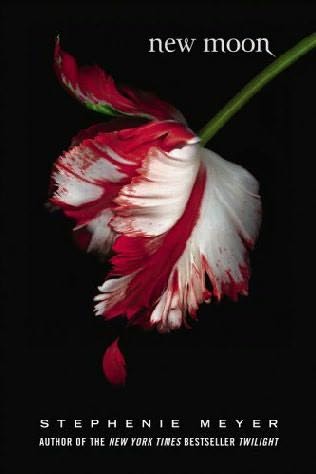
New Moon

Yesterday, I finished New Moon the sequel to Stephenie Meyer's Twilight.  And I think that the best I can say for it is it's really kinda uninteresting.  I mean, it's like Bella is all torn:  should she be true to Edward, or should she move on to Jacob, who is not terribly interesting, as a character, but is certainly more age appropriate as a boyfriend.  And that's about all there is to it.  I have to admit that I enjoy a good YA high school-romancy novel; I'm all for that.  And, at least so far, that's about all that Meyer's Twilight Saga is.  The vampire / supernatural / pseudomythical stuff reads like a veneer and nothing more.  And as YA romance, it's OK, not great but OK.  But I really can't see that it's anything more.  And really, silly YA romance novels are A-OK.  But why are we pretending that this is something more profound?  I don't get it.  Interestingly, there are moments where the novel could become something more.  Bella, for example, faces several moral delimmas--her values come into conflict, and it starts to look like she's forced to make an ethically complicated, difficult decision.  But in the end, she doesn't really agonize over these decisions; they come easily.  And she often doesn't have to make these difficult decisions--the plot somehow intervenes and makes them for her.  And I have to say that there's nothing especially interesting (and certainly nothing sexy, IMO) about the Byronic, brooding vampire, caught between his bloodsucking nature and his revulsion over this nature.  This is somehow so passe.  I want to say, "Dude, you are a vampire.  Deal with it."  I guess that this conflict, again, could allow for something more profound to happen in this work, but Meyer never really commits to "going there" and dealing with difficult questions.  And still, noone seems interested in the fact that, at the end of it all, Edward is basically very controlling and even manipulative when it comes to Bella  Given current statistics pertaining to relationship violence, especially among teens, isn't this about the last thing our society needs?  I mean, here we are, encouraged to really romanticize the relationship between the 17-year-old female mortal and her 110-year-old vampire lover, when it's just a repackaging of the same old controlling boyfriend.

So Over It

Ok, as I'm midway through the final week of the semester, I have to just say that I am so over it.  I'm ready to be done.  I'm tired of reading bad, incoherent essays.  I'm tired of acting supportive.  I'm just tired.  I'm feeling really kinda worthless these last few days, and it's like I have nothing left to give to my job.  And although I know it's totally normal for me to feel this way at the end of a semester, it still really sucks.  I mean, I don't have any semblence of patience or tolerance left--I guess that I'm just descending to short-tempered and snippy, with students particularly.  And while I hate feeling that way, there's also part of me that feels like saying to the students, "Hey, you deserve this.  You've turned in crap work all semester, and now it's catching up with you.  You have consistently ignored instructions on assignments and have refused to meet with me all the times I required individual conferences.  I had those conferences so that I could gently discuss the problems you've been having in class in time for you to change and somehow redeem your grade.  But you blew it off, and now it's too late."  I mean, that's life, right?  It's not so much that I hate to be the bad guy; it's more that I hate dealing with all the crap students can sometimes give when their grades turn out to be lower than they'd hoped.  And really, it always astounds me when a student has earned, say, Cs and Ds on every assignemnt and then acts shocked when he gets a D+ for his grade in the class.  That kills me.  Often, they send not just whiney but downright threatening e-mails:  "If we can't resolve this, I'll be forced to go to the dean."  And I always think, "Be my guest.  I'm over dealing with you, and the dean is not going to magically change your grade just because you think she should."  I guess that all the bad essays are bringing me down.  It's like once finals week rolls around, I'm the Grinch or something.