Showing posts with label reading. Show all posts

11 June 2009

Update on Summer Reading

So I thought it would be of benefit to post a quick update on my summer reading.  Again, it's the whole thing about having goals (see post dated 17 May).  This morning, I finished _Harry Potter and the Chamber of Secrets_.  For those of you not in the know, that's the second of seven in the Harry Potter Series.  I've also read about 2/3 of Wilkie Collins's _The Woman in White_.  With my mom here for two weeks, I didn't get as much reading done as I might have liked, and that's OK because spending time with mom was so great.  I do have in my possession most of the books I'd like to get to this summer.  I've refined and prioritized my list a bit.  So here's the revised list in the order in which I think I'll be reading.

1.  Finish _Woman in White_.

2.  Mrs. Dalloway

3 and 4.  Start the Old Curiosity Shop and An Abundance of Katherines (Dickens requires being broken up by light reading)

5.  To the Lighthouse

6.  Vanity Fair

7.  The Waves

8.  Trollope's The Warden

9.  Till We Have Faces

10.  Eliot's Middlemarch

11.  Gaiman's The Graveyard Book

12.  Anna Karenina

13.  Intersperse the rest of the Harry Potter Series with the above, just to break things up

14.  Intersperse a variety of feminist literary theory, which I'm reading in part for an independent study.  I need to get started on deBeauvior's The Second Sex.  I'm really not feeling up for this.

I'm enjoying revisiting the Harry Potter series.  I've been watching the movies on DVD too, partly in anticipation of The Half-Blood Prince opening this summer.  I do not think that the Harry Potter series is great literature.  But I do think it's clever and interesting.  And clearly, what Rowling does speaks to our culture in a way that few literary works seem to have done.  I could go on and on about it, but I'll spare you that.

I'm not feeling so enthusiastic about the theory I think I'm supposed to be reading.  I mean, it's just feeling a little depressing at the moment.  And what I really want to be reading is fun stuff, mostly from the YA section at the library.  And just because I have this whole list going does not mean that I can't and won't be reading fun stuff from the YA section.

One more observation about summer reading.  I really enjoy sitting on the deck and reading.  So completely relaxing.  It's supposed to rain later, or I might be tempted to spend the day reading outside.  But I also like getting up early (this morning, Fen woke me at 5:15) and reading all morning, sometimes in bed, sometimes on the couch.  There's something peaceful about the quiet early mornings around here.

On an unrelated but exciting note, bears have been seen in my neighborhood the past two days.  And by "neighborhood," I mean within 1/8 of a mile of my home.  I don't know why, but I find that very exciting!  For those of you who don't know, Guinnie is a little bit nervous of bears, but she figures she could outrun a bear or at least run faster than Polly.

17 May 2009

More on Summer Reading

Ok, I know that I'm obsessing about planning my summer reading.  I also know that probably noone cares, besides me.  And I'm fine with that.  I guess that I feel like in order to actually get anything done, I need to have goals.  And those goals seem real when I say them aloud, you know?  So here's my summer reading list, so far.  It needs to be prioritized somehow.  I haven't got to that yet.


Reading List, Summer 2009
In no particular order:
1.       Mrs. Dalloway
2.      An Abundance of Katherines
3.      Old Curiousity Shop
4.      Finish Dalgleish novels
5.      To the Lighthoues
6.      Harry Potter Series
7.      The Waves
8.      Woman in White
9.      Till We Have Faces
10.  Graveyard Book
11.  Thackery
12.  Trollope
13.  Eliot
14.  Forsyte Saga
So this’ll work if I read one book / week.  Oh, except for that HP is one entry.
Then, plus I have all that feminist theory I’m supposed to be reading.

13 May 2009

John Green--The Next Big Thing in YA Lit

So my considered (dare I say "expert") opinion is that John Green is the next big thing in young adult lit.  And seriously, I'm making a career out of reading YA lit.;  So here's the break down:

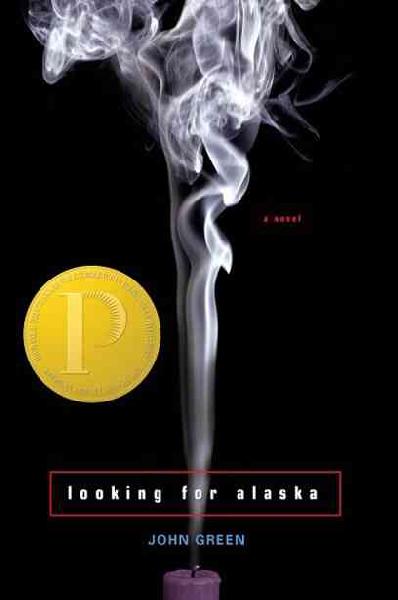
A couple of weeks ago, I read Green's Looking for Alaska.  This novel was published in 2005, and many critics have, apparently, compared it to Catcher in the Rye, which I think is highly overrated.  But maybe that's just me.  So Looking for Alaska was not wonderful, didn't change my life, but it was very good.  And I read a lot of YA lit, and most of it is crap.  I've been reading some of the Gossip Girl series, and seriously, those are so very vapid that 48 hours later, I can't even remember what the books were about.  So to find contemporary YA novels that are actually meaningful is always exciting and refreshing.  So basically the novel follows a nerdy protagonist Miles (oh, he's obsessed with "last words" that is, what people say on their deathbeds) as he goes away to boarding school.  He soon meets Alaska, with whom he promptly falls hopelessly in love.  Alaska is far too cool for our protagonist, but he becomes friends with her.  And I supppose that the novel is about Miles's attempt to really understand Alaska, but it becomes his attempt to find himself.  And maybe what he finds is, in part, that other people are unknowable.  I like Miles, as a character, and maybe that's just because, as some of you know, I just really tend to like nerdy men.  Miles feels familiar and irresistable.  A librarian colleague of mine says that the book glorifies underage drinking and sex and such.  I would say it's not so much a glorification as an authentic representation of teenage behavior.  And that's certainly not to say that all teens behave like Miles (or more accurately, Miles's friends), nor am I saying that it's acceptable behavior.  It just is.

Green's second novel is titled An Abundance of Katherines.  It is high on my reading list, along with The Old Curiosity Shop.  That seems like an odd paring.

Yesterday, I read Green's Paper Towns, his latest work.  I have to say that although I enjoyed it and appreciated it, it felt a lot like Looking for Alaska.  Here we have another nerdy teenage protagonist, Quintin, or Q.  He's hopelessly in love with Margo, the too-cool chick next door.  Like Alaska, this young woman is unobtainable but also incredibly troubled.  And Q. feels the need to save her, in a very literal sense.  In his quest to save Margo, Q. grapples with the problem of our inability to really understand or even know another person.

I say that Paper Towns and Looking for Alaska are alike, and they are.  Maybe that shouldn't detract from our ultimate enjoyment of these novels.  Green's protagonists are lovable, nerdy teenagers, on the cusp of adulthood, and they are dealing with questions that certainly seem universal.  And while they may not find the answers they hope for, the novels move toward finding meaning in our relationship with the world around us.  This seems to me to be an essentially optimistic way of looking at life and and young adulthood.  In the world dominated by Gossip Girl and the Princess Diaries, I'll take Green's novels any day.

A few more fun facts about John Green and his work:  Apparently the rights to all three novels have been purchased by movie studios, and Green is currently writing a screen play of Paper Towns.  Green can be seen weekly on YouTube, where he and his brother, post vlogs directed towards the "nerdfighters," their loyal followers.  Green also owns Willie, who is quite possibly the fourth cutest dog in the world, after my Bostons, of course.

12 May 2009

Reflections on a Sick Day

So on Sunday, I had a fever and body aches for most of the day.  And despite my initial panic related to swone flu, I now seem to have recovered.  But yesterday, Monday, I stayed home from work.  I should add that there was no real reason I needed to go into work.  We're in final exam week, and I didn't have any finals to administer on Monday.  So a sick day, a do nothing day seemed in order.

One thing I did with my sick day was to get caught up on some reading I'd been meaning to do.  I read the first 150 or so pages of Wilkie Collins's The Woman in White.  Collins is a contemporary of Dickens and writes in the same sort of way.  Anyway, here's something I've noticed only recently:  I really, really enjoy the Victorian "triple decker" novel.  This is worthy of comment only because for years I maintained that, with a few notable exceptions, the long, Dickensian novel was not for me.  And Dickens himself rather annoyed me, with the exception of A Christmas Carol.  But last summer, I read Collins's The Moonstone and enjoyed it.  I also read Dickens's Bleak House, not so much because I wanted to but because I thought it was something I should read at least once in my life.  Much to my amazement, I really, really enjoyed Bleak House and would like to move on to either The Old Curiosity Shop or Our Mutual Friend.  So do our reading tastes change as we get older?  When I think of the books I really, really loved as a child and young adult, I know that I still really, really love these works--The Lion, the Witch and the Wardrobe, Frankenstein, The Wind in the Willows, Little House in the Big Woods, which is by the way the first chapter book I read at the ripe old age of six.  But I'm also finding that I'm growing to love works that didn't appeal to me, not at all, when I was younger.

07 January 2009

The Lightening Thief by Rick Riordan

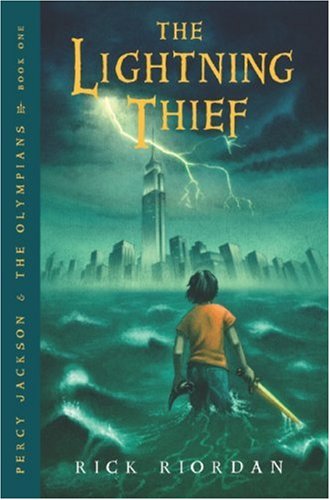
Ok, so I really enjoy juvenile and YA novels, especially fantasy.  It used to be my guilty pleasure / guilty secret.  But now that I have a job that warrants reading all this sort of thing, I can feel somehow justified.  But let's face it:  I just really enjoy this sort of thing.  Recenly, my brother John recommended Rick Riordan's Percy Jackson and the Olympians series, and last week I picked up the first in the series.  It was actually much better than I'd anticipated.  At first, I was just annoyed by the protagonist--I found Percy to be whiney and not at all likeable.  But as the novel progresses, and as Percy endertakes a quest of heroic proportions, he grows and develops in such a way that he becomes likeable and sympathetic.  So here's the quick summary:  12-year-old Percy Jackson, who lives in contemporary America, discovers that his father is one of the classical gods.  Olympus has somehow been relocated to the top of the Empire State Building.  And Percy must undertake a quest to recover Zeus's lightening bolt of power.  Riordan uses classical characters and themes in creative, interesting, and not entirely predictable ways.  In all, it was a good read.  John basically told me that it's clearly written for eighth  or nineth graders, so it reads really quickly but that it's both entertaining and interesting.  And he's right.  That pretty much covers it.  Next in the series is Sea of Monsters, and I hope to read it soon.

31 December 2008

2009--The Year of Dante

So I've decided that 2009 shall be my year of Dante's Divine Comedy.  Or at least, January through May will be devoted to Dante.  Over the past couple of days, I've been reading various introductions and background-type essays.  But this morning, I sat down and read Canto I of the Inferno in a couple of different translantions (Sayers and the Hollanders) and then read all kinds of commentary and notes just on that first Canto.  And I've read Dante before, but I feel like for the first time I'm not just studying Dante but am really understanding Dante.  It's not that I'm just getting it intellectually; it's more that I feel like the whole thing is actually speaking to me, you know?, on many levels at once:  imaginative, emotional, spiritual.  And it seems to me, right now anyway, that that's the whole thing about Dante.  Yes, it's allegory, but it's more than "just" allegory.  It operates at the literal level, but it's operating at all these different levels of human experience all at the same time.  And none of these levels or meanings is exclusive of the others; rather, each informs the others and enriches the others.  I know that what I'm getting at is maybe obvious--it's what I've known intellectually about Dante all the time.  But I feel like for the first time I'm experiencing it, rather than just understanding how it's supposed to work.  And I marvel at the skill of it all.  I'm not just understanding, but I'm being moved, changed.

But really, what's motivated this particular look at Dante is that I'm teaching Dante next semester.  And as I've been reading about Dante and thinking about Dante and finally reading Dante's work, all I think, in reference to the course, is, "How are my students going to deal with this?  How are they going to respond?"  More specifically, I'm concerned that they might not respond at all, that they might just shut down.  Reading Dante is no easy task.  And I'm afraid that the room will be filled with apathetic students who don't really know how to work at this task.  The translators and commentators I've been exploring seem to agree that reading Dante requires participation and work on our part, and in my experience, many of my students just seem interested in a passive reading experience, if they are willing to read at all.

But really more significant, I think, that the necessity of our being active readers is that Dante's way of thinking about the world is simply so alien to so much of postmodernity.  Dorothy Sayers says, "We must also be prepared, while we are reading Dante, to accept the Christian and Catholic view of ourselves as responsible rational beings. . .The Divine Comedy is precisely the drama of the soul's choice."  This way of thinking about the self and the world seems to me to be so foreign to much of our culture.  In Dante's world, sin matters; it enslaves us in the present world and for all eternity.  As a culture, we can think in terms of sex addiction, but most of us don't really buy the idea that lust, one of the seven deadly sins, can destroy our soul.  I, for one, am willing accept Dante's general scheme of things; the choices we make do matter, and maybe what matters the most is how our inner selves are affected.  Sin and evil do exist.  But in a world where absolutes are eschewed and a notion of the soul is thought of as simply out dated, what place does Dante have?  And how can I convey to my students that these questions matter, or that at least to make sense of Dante, we have to suspend our disbelief?  I'm feeling so inadequate to the task at hand.

But Dante.  He's like my Beatrice, at least for the moment, a bright ray of light, leading the way to some sort of Truth.