Showing posts with label pop culture. Show all posts

24 January 2009

Buh-Bye DirecTV

OK, I've decided that I''m getting rid of television.  I'll keep my two TVs, and I'll watch DVDs, but no more satellite TV for me.  Before I go further, I should say that I really do love DirecTV.  I love watching the cable news channels and USA and TNT and the Food Network and ID, which is new-ish.  Anyway, I love it.  But I've come to the conclusion that I'm watching more TV than can possibly be good for me.  It's not a good sign that I know, every single day, what's transpired in the Caylee Anthony case.  It's not a good sign that I sleep with the TV going all night.  It's not a good sign that I know what's on Bravo almost every night.  Also, I have to give a shout out to the customer service people at DirecTV.  Seriously.  When I've had questions, which isn't often, I've always been amazed at how helpful they are.  And it appears that they've not outsourced calls to techs in another country.  I hope this isn't too un-PC of me, but I hate it when you call and 800 number and get someone who just doesn't speak English very well. 

Anyway, I've been thinking, for quite some time really, that I'm simply watching too much of what I call "default TV."  That's when I turn on the television and zone out in front of something I don't necessarily really, really want to watch but it's just what's on.  And I feel like I am just wasting too much time, time that could be spent reading or writing or crafting or relaxing in a more productive way (read: yoga, bubble baths, and meditation practice).  I mean, I think that I'll be a happier, healthier person without TV there to distract me.  Oh yeah, I've also fallen into the habit of just having the TV running in the background all the time when I'm at home.  So I feel like getting rid of TV will free up my time and attention (not to mention my finances) for other more productive or more bliss-producing activities.

Finally, I just feel like I need some changes in my life.  I feel like I keep working and working and working on somehow getting my life in order, getting my life on track.  And believe me, it often feels like it's dramatically, inexplicably derailed.  When I feel like this, it always seems like some big change shakes things up and helps make the adjustments I'm looking for.  This is a much larger issue with me, larger than whether or not to watch TV.  It's just that every week, almost every day, I feel like I can never get enough done.  If I manage to stay on top of it all at work, which I often do, it seems like my house is a total disaster.  If I'm really disciplined about one thing, say what I'm eating, I can't seem to be at all disciplined about another.  It's so frustrating.  And I keep trying and trying to be better about it all, but I'm not sure I've made much progress in the last five years (or maybe ever!).  Anyway, I know that many of you may not understand, but getting rid of TV feels like a way to move towards getting my life and myself in order.

Not to fear:  I am keeping Netflix!

07 January 2009

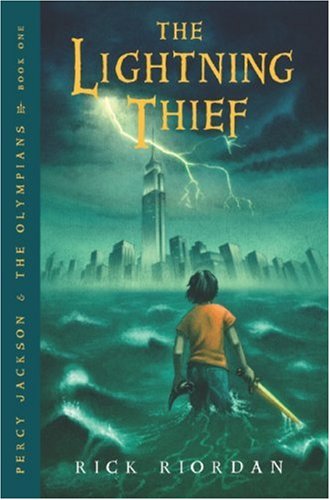
The Lightening Thief by Rick Riordan

Ok, so I really enjoy juvenile and YA novels, especially fantasy.  It used to be my guilty pleasure / guilty secret.  But now that I have a job that warrants reading all this sort of thing, I can feel somehow justified.  But let's face it:  I just really enjoy this sort of thing.  Recenly, my brother John recommended Rick Riordan's Percy Jackson and the Olympians series, and last week I picked up the first in the series.  It was actually much better than I'd anticipated.  At first, I was just annoyed by the protagonist--I found Percy to be whiney and not at all likeable.  But as the novel progresses, and as Percy endertakes a quest of heroic proportions, he grows and develops in such a way that he becomes likeable and sympathetic.  So here's the quick summary:  12-year-old Percy Jackson, who lives in contemporary America, discovers that his father is one of the classical gods.  Olympus has somehow been relocated to the top of the Empire State Building.  And Percy must undertake a quest to recover Zeus's lightening bolt of power.  Riordan uses classical characters and themes in creative, interesting, and not entirely predictable ways.  In all, it was a good read.  John basically told me that it's clearly written for eighth  or nineth graders, so it reads really quickly but that it's both entertaining and interesting.  And he's right.  That pretty much covers it.  Next in the series is Sea of Monsters, and I hope to read it soon.

30 December 2008

Martha and Conan

I've been meaning to post this for a while; it's too funny.

29 December 2008

The Contemporary Freak Show

For some reason, I've always been interested in the "old school," P.T. Barnum-style side show.  In fact, I really like the term "freak show," probably because I've always been morbidly fascinated by the 1930s film Freaks, which you, dear reader, should see if you've not already.  But for better or worse, in our society, we seem to have decided that the freak show is no longer socially acceptable.  And I do think this cultural movement is for the better:  I cannot really at all justify the all-too-human tendancy to objectify and gawk at the disabled.  And this is what the freak show (as opposed to the "geeks" in the sideshow) is really about.

Lately, I've found myself watching the Discovery Channel and its sister channels Discovery Health and The Learning Channel a little too frequently.  The line-up includes such favorites as Jon and Kate Plus Eight and 17 Kids and Counting, which  are interesting and seemingly-benign looks at families which by society's standards are extraordinarily large.  But Little People, Big World, often follows Jon and Kate.  LPBW follows the Roloff (spelling?) family, composed of two LP parents and their four children, only one of whom is a LP, or little person.  In many ways, they are an average family, but isn't the whole selling point of the program that, at least in height, they are not at all average?  I mean, don't we watch it as our great-grandparents might have gone to the freak show?  In the end, the Roloffs do live much like an average, upper middle class family, however, and I don't think that we as viewers tune in just to gawk, although that's certainly part of the attraction.  We might say some of the same things about the Style network's Ruby, which follows a morbidly obese woman as she both attempts to lose weight and negotiate a world not really suited to her current body.  And on the one hand, the program is interesting in that rather than encouraging us to objectify Ruby, we are encouraged her to see her as fully human, with the struggles and emotions just like all the rest of us.  And yet, she's only notable because she's the "fat lady."

I am much more concerned about an entirely different set of programs I've recently seen advertised as part of the Discovery / TLC lineup.  Most of these seem to be one or two time "specials," as opposed to entire series, and even their titles are evocative of Barnum's side show, titles like Treeman and Mermaid Girl.  In both cases, we are invited to gawk at people with conditions that lead to horrible disfigurement.  I only saw a small portion of each of these, but it seems like the majority of each hour-long program is devoted to exploring the medical aspects--the various approaches to possible "cures," each individual's life-expectancy, how the condition has developed over time--of both individuals.  But really, I don't see how this is much different from the early-twentieth century side show.  We, as viewers, are still pointing and staring because of the disability.  We may or may not feel some compassion, but compassion does not seem to be what motivates us to watch.  And clearly, I'm not necessarily pointing the proverbial finger at all of you as viewers; I've watched too.  I've seen various specials on types of dwarfism and how the individual is affected, the specials about conjoined twins, and notably the recent spectacle of the Indian girl with either six or eight arms (apparently, she's considered by some to be an incarnation of a particular deity.)  I have to admit that I think documentaries about transsexuals are especially interesting.  But the selling point, the attraction of each of this is that each is about a "freak," about someone who is not like the mainstream because of a pathology, a malady, a disability.  We see these conditions as something to be corrected, and we treat these inidividuals as objects or stand-ins, not as inidivudals.  I'm sure that Treeman and Mermaid Girl have actual names, but we're willing to reduce them to interesting and notable and valuable as nothing more than their freakishness.

But my question is this:  are many of these programs different from the 1930s freak show?  The medium is different in that instead of carnival barkers encouraging us to pay and extra nickel and step inside a tent, we simply flip to a particular channel on Sunday night.  But aren't our motivations the same?  Don't we tune in to see the physical deformities?  to marvel at the freaks?  to point and stare and feel both pity and terror?  Isn't this the same as the now out-of -fashion freak show?

01 December 2008

I Heart Umberto

So here's my self-depricating preface:  I realize that claiming I just LOVE Umberto Eco is silly, at best.  However, I consider this progress of a sort.  I mean, I used to claim I was "in love" with Inspector Morse, and he's a fictional character.  Eco (or "Umberto" to his closer associates) is, at least, a real person.  And he's brilliant and wonderful and exactly the sort of academic I want to be.

So why, you may ask, do I love Umberto?  What makes him so great?  Hmm. . .where to begin. . .I love that he, of course, knows all about canonical literature, but he can connect it to pop culture in wonderful, insightful ways.  So one minute he's talking about Dante, and the next he's talking about Superman.  Superman seems to come up a lot, actually.  But I love that Eco realizes that elements of popular culture move us and inform us in the ways that serious literature can.

I love that Eco can talk about how language and literature work in this academic, informed way.  But he can so easily switch registers and explain why literature is powerful for the average reader.  Even more basically, I love that he acknowledges that language and literature are powerful, that they can move us on a level that transcends the literal and the logical.  I love that Eco recognizes the tension and balance between the openendedness of texts and the limited possibilities of interpretation.  But it seems to me that all the while, he allows that meaning does, in fact, exist and that it's not completely relative.  Eco realizes, of course, that ultimately words matter.  And he reminds us that texts and how we read them and even whether we read them--all these matter too.

But here's where I get silly.  I often wonder, "What would Eco think?"  This seems to be becoming my personal mantra for how I think about texts.  It's a reworking of the WWJD.  (Side note:  I REALLY want a tee shirt that says, "What Would Gandalf Do?" but that's another post).  And when I watch Lost or listen to Joni Mitchell's "River" until I cry or read Dickens, I have this fantasy about discussing it with Eco.  In my fantasy, we drink beer.  Does he drink beer, I wonder?  And he explains that Lost is powerful precisely because of the ways it taps into other texts we always already know.  And I tell my favorite episode from the Thursday Next series--the one where Hamlet, in the midst of identity crisis, is thrilled to discover that Mel Gibson plays Hamlet.  Hamlet, you see, LOVES Leathel Weapon.  And this is funny to me but powerful in a way that Eco could explain.  In "On Literature," Eco tells us that literature has an "intangible power," and so we understand why Hamlet, identity crisis and all, moves us.  Over beer, Eco also explains to me all kinds of grand stuff about the Middle Ages.  This part of the fantasy is probably a rehashing of his "Ten Little Middle Ages."  And at some point, I tell him that Foucault's Pendulum is kick ass.  And after enough beer, we talk about Salman Rushdie.  This is my perfect fantasy.  *sigh*  And so I guess that I'm "out."  I'm positively in love with Umberto Eco, dispite the fact that he doesn't know that I exist.  But hey, a girl can dream.

10 November 2008

Morning Joe Drops the "F Bomb" on Live TV!


Did anyone else hear this this morning? Joe says the F-word and seems oblivious. When Mika calls him on it, he reverts to the "ambien and vodka" routine.