22 October 2008

The First Snowfall of the Season. . . .

It sounds much more cozy / romantic / wonderful / dreamy than it actually is.  This morning, I woke up and took the dogs out to a gentle snowfall. If I were still living in CA, I would think, "Wow!  the first snowfall sounds so lovely. . ."  Really, it was just kinda discouraging.  I mean, it was cold, and the dogs were wanting to just rush back inside rather than do their "business" in the yard.  And I just kept thinking that I had six months of this kind of weather to look forward to.  I'm trying to make the most of the change in the weather--I've been wearing boots and scarves this week.  Winter does afford fun, creative fashion possibilities.  But really, the cold is just a big inconvenience.  And knowing that it will drag on and on is really what brings me down.  The days are getting shorter--I've been leaving for work while it's still dark out.  And I've been having some conflict at work.  And for the last 10 days or so, I've just had a lot of work to do every day.   It's so hard not to get discouraged and overwhelmed.  This post is not turning out as I'd planned--I guess that's OK.  But I hadn't posted in ages, and it seems like I should say something profound or interesting about books or something.  But I'm just cold and tired and craving MAC eyeshadow, which I'm somehow rediscovering lately.  Maybe MAC eyeshadow deserves its own post.

30 September 2008

Nixon, Toothpaste, and Sodomy

Many years ago (well, a couple years ago anyhow), I was with A. looking at a program for an academic conference.  And there was this panel with three papers that had no discernable connection.  So A. says, "It's like having a panel titled, I don't know, 'Nixon, Toothpaste, and Sodomy."  The point being, of course, that these three things just don't fit.  And so, in my mind, a miscellaneous, seemingly-random collection of thoughts has, ever since, been "Nixon, toothpaste, and sodomy."  And really, as a deconstructionist, A. should appreciate the suggestion that by placing these three together, maybe he's suggesting that they do somehow fit together.  And as a Freudian, A. might be able to give us insight into the possible, non-conscious connection between three seemingly- random nouns.  And now that I write this, I'm missing A. and realize that I should e-mail him.  I'll leave it to the rest of you, or at least to Cara, to deduce who A. is based on these clues.

And "clues" is my transition to the next thought in this series.  I may have posted about this before--I don't know.  I have decided that my all-time favorite etymology is that of the word "clue."  And as I've been reading and teaching all these great, quaint, classic, cozy murder mysteries, it's been particularly on my mind.  "Clue," originally spelled "clew" is the word for a ball of yarn:  think old ladies knitting while kittens bat around the yarn.  And when Theseus entered the labyrinth to battle the Minotaur, Ariadne gave him a clew of yarn to find his way back out.  You know, it's almost like Hansel and Gretel leaving crumbs in the wood.  Theseus is to leave the yarn at the beginning of the labyrinth and to thread it out as he moves along, so that once the minotaur is faced, he can follow the thread back to the beginning.  And, according to the OED, the universal source of all linguistic knowledge, this is the sense from which our use of "clue" develops.  The notion is that the detective, or anyone really, can pick up a single thread of a narrative and follow that thread through to the logical conclusion.  And as I read, I keep picturing the characters (this is especially appropriate for Miss Marple) following threads of conversations and incidents back to the murderer.  In The Murder of Roger Ackroyd, the narrator describes an encounter with Poirot: "He and I lunched together at an hotel.  I know now that the whole thing lay clearly unravelled before him.  He had got the last thread he needed to lead him to the truth."  And again, it's the image of unrolling that ball of yarn and following the thread out of the puzzle.  This image absolutely fascinates me.

And finally, third in my series of three seemingly-random things:  I have announcement to make.  In the near future, if all goes according to plan you will be able to find me here on the net.  More to come!

23 September 2008

Thursday Thirteen: Songs About Cities

Today's not Thrusday, and I haven't even done the TT in a while.  However, on the way to work this morning, I was listening to Creedence, and they have that great song "Lodi."  So I'm driving along, singing along, and I get to thinking:  Hey, there are lots of songs about particular cities.  And so here I offer, in no particular order, a list of thirteen songs about cities, some with commentary.

1.  CCR's "Lodi."  We'll start with this one, as it's the motivation for the list.  When I think Lodi, I think German sausage, which is maybe a little odd because I don't even remember the last time I ate German sausage, and I'm pretty sure it wasn't actually from Lodi.  But when I was a child, we'd sometimes have German sausage from Lodi at church functions.  Apparently, there's a butcher there who sells the "best" German sausage.  I think that my cousins J. and M. have a bakery or something they like in Lodi too.

2.  Glen Campbell's "Galveston."  I don't have too much to say about this one, other than this:  my father is, apparently, distantly related to Campbell.  I guess that means I'm related too.  As far as I'm concerned the most interesting thing about Glen Campbell is that he was once one of the Beach Boys.

3.  Otis Redding's "Sittin' on the Dock of the Bay."  Although the city's name isn't the title here, this is still a song about a city, right?  And it's a good one.  And in my mind, it's somehow connected to "Midnight Train to Georgia," which is also pretty good and about a particular locale.

4.  Marty Robbins's "El Paso."  Ok, this may be the all time best song about a city.  I love this one.  For one, the lyrics are fun.  Interestingly, he also recorded "Feelena" and "El Paso City," which taken with "El Paso" make up a song cycle, to my way of thinking.

5.  Garth Brooks's "Callin' Baton Rouge."  I don't have much commentary for this one; it's just fun.

6.  "New York, New York," especially when sung by Frank Sinatra.  Although it makes no sense to do so, I like to sing this one to and about my dogs, especially Guinn, substituting the line "these vagabond paws."

7.  Marc Cohn's "Walkin' in Memphis."  I have always thought Memphis would be a fun place to live; I could totally get on board with the whole rockabilly thing, and I don't just mean the music, I also mean "rockabilly kulture."

8.  "Meet Me In St. Louis," especially when sung by Judy Garland.

9.  Jimmy Buffet's "Margaritaville."  Wait, does Margaritaville count as a city?  I love the line about "Blew out a flip-flop / Stepped on a pop top."  That's genius.

10.Elvis's "Viva, Las Vegas."  OK, first I love the movie with Elvis and Ann Margaret.  But I am positively horrified by the Viagra commercials on TV in which they sing "Viva, Viagra."  It just makes me uncomfortable, like watching a Will Farrell skit on Saturday Night Live, only it's funny when it's Will Farrell.  Plus the TV commercials for Viagra just seem kinda low class.

11.  What about the Arlo Gutherie song about "The City of New Orleans."  OK, so the song's about the train named after the city--I get that.  And as such, I guess it's not really a song about a city, but still, it's a goodie.

12.  "City of Angels," by the Red Hot Chili Peppers.

13.  And last but certainly not least we have Dwight and Buck's "Streets of Bakersfield."

Honorary Mention, because they are not specifically about a single city:  Johnny Cash singing "I've Been Everywhere" and George Straight singing "All My Exes Live in Texas." 

21 September 2008

Intertextual TV: Lost

So this weekend, I started watching the TV series Lost.  And although I've only seen the pilot and maybe the next three or four epoisodes, I LOVE it!  It seems interesting and smart, which in terms of TV viewing is rather a departure for me--I normally like mindless TV.  But I keep thinking about it in terms of all kinds of other texts.  And it seems that it's intended that way.  I mean, how can we not think about it in connection to Lord of the Flies?  But that's the obvious comparison, right?  So far, the series clearly references Alice's Adventures in Wonderland.  But I also noticed one of the characters reading Watership Down.  And so I'm thinking, "Oooo!  It's an epic about building a new society."  And that's pretty obvious, right?  So, we've got Lord of the Flies, Alice, and Watership Down.  Charlie's tattoo says "Living is Easy with Eyes Closed," which of course is from "Strawberry Fields," and we have a character named John Locke.  And yeah, this is all kinda obvious.  But mixed with the fantasy elements (dare I say "magical realism"), all I can think is Umberto Eco.  If Eco were to create a TV series, would it be like this?  I mean, really, I bet that Eco watches Lost, because it all feels like Eco's novels to me.  This is so like The Island of the Day Before or Baudolino.  In those novels we see characters who somehow end up in fantasy worlds that play with what they know about science and myth.  And so my thought process is something like this:  Lost, intertextuality, magical realism / fantasy, Umberto Eco.  So what do I make of it all?  Right now I don't know, other than I'm excited to see how the series progresses.  And I'm interested to see what other texts come up--I'm betting Dante is related to all of this somehow.  I'm really hoping that Eco publishes an essay on Lost, because that would be kick-ass.  I guess this is how English teachers watch TV.

16 September 2008

Follow Up to Last Week's Post on Palin

Last week, although it somehow feels like it was an age ago, I know I posted a longish "thingy" about Palin.  And I continued to think about the topic and how I was feeling about it, and some of you had interesting things to say in response.  And so, it seems that a further exploration of the general topic seems to be in order.

So C. pointed out, and I think that she's right, that there's this weird, uncomfortable, and ultimately mislead double standard.  It's like some people think Hilary C. is not to be admired because she's been ambitious and has been open about it.  In contrast, Palin is presented as this "Hockey Mom" who has really been a stay-at-home mother at heart but has somehow fallen into this whole vice presidency thing (I almost said "farce"), and that we're supposed to find Palin inspiring and acceptable because she's been committed to her family before her career, because she hasn't shown the ambition that Hilary has.  And, really why is it acceptable, at least according to some segments in society, for the Hockey Mom to run for office and somehow offensive when the ambitious mom does?  Don't get me wrong--I don't see it this way.  And I don't want to suggest that I think Hilary has been anything other than a good mother--I certainly don't know anything about her as a mother other than to say that Chelsea seems to have turned out well.  But what really gets to me is this:  Palin must have been and must be ambitious and hard working.  OK, so I don't think she's particularly qualified for second in command, but she has been a mayor and even a governor, albeit for a short amount of time.  But one doesn't get to be a governor, even of Alaska, without hard work and ambition.  She's been personally ambitious; she's worked to advance her career.  I think this is fine.  But it bothers me when some want to act like she's admirable because she's been somehow non-ambitious, somehow antithetical to Hilary in this regard.

Secondly, as I am prone to do, I turned my analysis of Palin really into an analysis of women's position in society and an analysis of myself and my own position in a variety of social structures.  Hey, we all know the personal IS the political, right?  Or is it the political that's personal?  I forget which it is.  But I went on and on about not having children, not having a "partner."  And I do love that we can use the term "partner."  Anyhow, when I said that I feel somehow "broken" because I don't have a partner, I really meant that I feel like there must be something wrong with me or I wouldn't be alone.  I mean, I know this is not rational, but too often it simply feels like no one wants me.  And the reasoning goes like this:  "No one wants me.  This must mean that I am undesirable.  There must be something wrong with me, or someone would want me.  I must be broken beyond repair."  Again, I am saying clearly, this sort of thinking is not realistic or reasonable.  But still, it feels like no one wants me, therefore I must be un-want-able.  And to be fair, I think I've had more than my fair share of dramatic (shall we say melodramatic?), extreme, heart-breaking rejections from men I've really, truly loved.  I seriously think I may have PTSD from the whole Stamp thing.  But it always feels like if I'd been somehow better, maybe he would have wanted me, maybe he'd want me now.  I think that most people would have some insecurities in the wake of some of this, right?  (So I'm sparing you all a long, melodramatic narrative of how it went down with Stamp; I'm assuming that if you know me well at all, you know the situation.  And the truth is (I hate admiting this) that all this time later, I sill miss him and think about him and wish that things could have somehow been different.  Please don't e-mail me to say that's silly.  I know it's silly, but it's just part of it.)  Anyhow, that's really only tangentially (or maybe not at all) related to the Palin question.  But the topic is, clearly, bringing up all kinds of difficult "stuff" for me.

P.S.  In future posts, I'll try to cut down on the parentheticals.  Bad writing style!

Ursula Le Guin: Gifts

I just finished the YA novel, Gifts, by Ursula Le Guin, and it was one of the most lovely novels I've read in quite some time.  I haven't read tons of Le Guin, but there's something beautiful and fitting and perfect about her clear, succint, almost sparse style.  And Le Guin is particularly insightful and sensitive in the way that she deals with the whole coming-of-age motif.  This particular novel would, I suppose, be classified as fantasy.  It's the story of an adolescent boy living in some sort of alternate universe in which individuals have "gifts," or what we might call supernatural powers.  These gifts are hereditary, and the main character, Orrec, has the gift of "undoing" or destruction.  As he matures, Orrec must learn to use this gift, lest it control him.  But, of course, his coming to terms with his gift is his coming-of-age, his growing into an adult, and this growing is painful and frustrating and fill of loss, but how could it be anything else?  As I sit here typing, it occurs to me that the genre of fantasy seems to be especially suited to the coming-of-age story.  And maybe that's simply because fantasy is almost always about the main character's quest, and the quest is, I suppose, really just a metaphor for growing up and finding our place in this world.  I am, I have to admit, particularly fond of the YA novel, and this is one of the very best I've read in quite some time.

Nifty Netflix Feature

I think that Netflix is just about the greatest thing since ever!  And if you click here, you can become my Netflix friend (or fiend!).  See what I've been watching, make recommendations.  The fun never ends!

10 September 2008

Edited (and Less Crazy) Pic of My Fenny-Love

K. was kind enough to edit the pic of Fenway that I posted yesterday.  Here's Fenway looking much more dignified.  Some might say that I'm biased, but I really do think he's just the handsome-est little thing in the world.  Here's a "joke" that A. made up:  What's the difference between Fenway and Sarah Palin?  The lipstick! 

09 September 2008

Stop the Insanity! Or What I Really Think About Sarah Palin, Or Why I'm Not a Very Good Feminist

I don't know where to start.  Like many of us, I have had Sarah Palin on the brain for the last ten days ago.  And I've officially decided, much to the consternation of some, I know, that I'm not going to vote in Novemeber.  I've also officially decided to not engage in conversations and certainly not snide comments about the candidates, the parties, or the process.   One reason I've decided not to vote is that, really, with the electoral college working as it does, I sorta feel like my vote doesn't count.  I mean, Vermont is certainly going to the Democrats, regardless of how I do or don't vote.  I don't think that's cynical of me; I think it's realistic.

But here's what I really think about Sarah Palin.  (Ok, I know that I just decided not to engage in conversations about the candidates, but I consider my personal rant far from a conversation).  Regardless of ideology and politics and all that stuff, which I do consider to be really important, I don't think that Palin is qualified.  I don't think that she has the requisite experience that I'd like to see in someone who could potentially be the leader of the free world.  Just for the record, I think the same about Obama.  I do realize that for both of them, part of the attraction is the perception that they are not entrenched in the establishment.  I guess that I understand that as a kind of selling point, but in Palin's case, I'm not buying.

I do feel that, at least for me, one positive that's come about as a direct resuly of Palin's being chosen as McCain's running mate is that many of us are revisiting some pretty big questions about women with careers and especially working mothers.  This topic is one that I find myself coming back to over and over.  I know that I've said before that I always feel like I've somehow been betrayed by feminism, as a movement (yes, I know that I'm talking about white, privileged feminism here).  I feel like feminism (or maybe 2nd wave feminism) has told us that in order to be happy and successful we need to have rewarding careers and fabulous marriages while we are super moms too.  I, for one, don't think that I have it in me to do all three of these at once.  In fact, at 33, I have accepted that I'll probably never have a child.  And I'm totally OK with not having children.  In fact, I don't see how I could work the way that I want to and still have it in me to be a good mother.  I know that many women do it and that many of them do it gracefully.  I am not one of those women, and I'm sure it has more to do with my own emotional weaknesses than anything else.  For a long while, I felt like I was supposed to at least want children, like there was something defective about me if I didn't.  Now I realize that, at least for me, it's a choice:  career OR children.  Or maybe I could, in theory, have both, but I can't imagine doing a very good job of either.  And over the last week, Mika Brzezinski, who I really like as far as newsy personalities go, has been talking about this topic in her own way.  And I appreciate what she has to say about Palin and being a working mother.  And Mika (don't you love how suddenly I'm all palsy with her?) says that for herself working the way she does is a choice and that it does take time and energy away from her children.  I know she doesn't buy into Palin's politics, but Brzezinski says she can identify with the sacrifices that working mothers make.  But the thing is that Brzezinski and Palin and even I have a choice.  Many women, especially single mothers, don't have a choice.  And really, aren't the mothers working 50 and 60 hours a week at blue collar jobs to house and feed their children, aren't they the real heroes?  And aren't they the ones we should be concerned about?  I mean, all these pundits going on and on about Palin and if she gets the big job, who will take care of her children.  Palin has a choice to make--talk about ProChoice--too many mothers, especially single mothers, don't have the luxury of choice.  And we don't talk about this often enough, it seems to me.  (Ok, here's where I get all "meta:"  I realize this paragraph lacks a single focus.  And I'm OK with that--I'm just sorto of thinking out loud on paper, or on screen.  Well, you know what I mean.)

And I haven't even begun to address how marriage and relationships might fit into the mix.  I believe that, in general, being a single parent is much more demanding and much more difficult than having a partner with whom to raise children.  At 33, I have begun to accept that I may never, never get married and have that kind of partnership in my life.  This, for me, is much more difficult to accept than the prospect of not having children.  But it's a possibility (a probability????) that I think I need to face.  And I have to say that not being married, or more specifically feeling like I have more than my share of spectacularly failed relationships in my past makes me feel like a failure.  I can be OK with never being a mother, but the idea of never having a fulfilling, intimate relationship makes me feel so broken somehow.  And I do feel a lot of societal pressure--it's like there must be something wrong with me if I can't do something so normal as sustain a relationship.  I know that my perceptions and reality aren't the same thing here; this is just how I feel much of the time.

I guess that what I'm trying to say is this:  thinking about Palin has, for me, brought up questions about how I, as a woman and as a feminist and as a product of a particular historical and cultural moment and as a product of a particular set of religious beliefs, define success.  Too often, I find that the definitions of a successful woman offered by the various societal groups with which I identify are definitions of success that just don't work for me.  And I'm not sure where that leaves me.  Right now, it leaves me with a job that I enjoy and that I really believe in.  But sometimes, I feel like that's about all I'm left with, and I don't know what to think or feel about that.

Oh, and one more thing:  I cannot make myself believe that reproductive rights are the central issue for women in the way that some others seem to think they are.  Maybe I'll post more on this later, or maybe I'll continue to avoid the issue.

Pics of my yard

These pics are the flower beds in my front yard, as seen from my window.  I'm not sure that they really at all show what things are looking like, as we near the end of what's been a very wet summer.  But my yard is truly a source of joy.
Here's a new pic of Fenny.  I like this one because it looks like he's smiling.  Also, he looks kinda maniacial, which he kinda is.  If I were better with Photoshop, I could make his eyes look normal, black, not all reflect-y.  But maybe the glowing eyes add to the maniacial feel of the pic.  Doesn't he look like he wants to say something?  I think he wants to say, "I love my mama more than anyone!"

03 September 2008

A Reading Update

As you can tell, I'm sure, from recent posts, I've been reading tons and tons o' murder mysteries lately. And something about it is very satisfying. I like feeling like I'm reading with a purpose, and I like feeling like my reading is centered on something--some theme, some goal. Over the last week, I've finished the first Sherlock Holmes novella A Study in Scarlet and P.D. James's A Mind for Murder. Oh, I've also read Edgar Allen Poe's three tales of "ratiocination:" "Murders in the Rue Morgue," "The Mystery of Marie Roget," and "The Purloined Letter." And I'm feeling in this state of synthesis where I'm living and breathing and thinking mystery, you know? When I get really into a writer or a genre or a class or whatever, I find myself going about my life, almost constantly mulling it all over in my mind. And I rather like that feeling--it seems to give me a sense of purpose. So two of the Poe stories I could do without, but "The Purloined Letter" is pretty smart. And in A Study in Scarlet, Watson and Holmes refer to Poe's Dupin. And, I don't know, it feels cool and smart and interesting to be tracing the development of something. And intertextual references always excite me anyway. So all this to say, I guess, that I'm just having a lot of fun with work, and that really seems like how it should be.

02 September 2008

"We Tell Ourselves Stories in Order to Live"

In "The White Album," Joan Didion opens by exploring why it is that we write.  And as I'm preparing for tomorrow's Freshman Comp class, I'm reminded of what Didion has to say:

We tell ourselves stories in order to live.  The princess is caged in the consulate.  The man with the candy will lead the children into the sea.  The naked woman on the ledge outside the window on the sixteenth floor is a victim of accidie, or the naked woman is an exhibitionist, and it would be “interesting” to know which.  We tell ourselves that it makes some difference whether the naked woman is about to commit a mortal sin or is about to register a political protest or is about to be, the Artistophanic view, snatched back to the human condition by the fireman in priest’s clothing just visible in the window behind her, the one smiling at the telephoto lens.  We look for the sermon in the suicide, for the social or moral lesson in the murder of five.  We interpret what we see, select the most workable of the multiple choices.  We live entirely, especially if we are writers, by the imposition of a narrative line upon disparate images, by the “ideas” with which we have learned to freeze the shifting phantasmagoria which is our actual experience.

Didion's is one of my favourite passages about writing, about why we write.  Maybe we don't write to live in a literal sense, and yet we write in the attempt to find meaning in a world that is meaningless.  Last night, I was watching Slings and Arrows a "dramedy" about a troup of Shakespearing actors who, in season 2, present MacBeth.  Some of them see a production of MacBeth at a local elementary school.  And as his wife goes mad, MacBeth thinks something like "I don't understand life.  It just goes on and on."  And as Didion points out, the attempt to find a narrative thread in our existence is the attempt to follow the thread or clue that could lead to some sort of meaning, we are searching for what MacBeth feels he's missing.  And "story" is a way to do so.  I always think this is so powerful and says so much not just about why we write but why we read and why the study of literature is important.  This seemed to be worth sharing.

28 August 2008

Dorothy L. Sayers: Clouds of Witness

Last night, I finished the second Lord Peter Wimsey book, Clouds of Witness, and I very much enjoyed it.  Sayers is really quite a good writer, and although Lord Peter can get a little annoying at times, I basically like him as a character.  But here's what's interesting to me, at least at the moment:  Lord Peter is written as a modern, secular kind of guy, but Parker, the police inspector guy that Lord Peter runs around with, is all Christiany and traditional.  Inspector Parker reads commentaries on the New Testament as his bed time reading.  Now none of this is particularly interesting in and of itself, necessarily.  But here's the interesting piece:  Sayers herself was very vocal and "out" about her own Christianity.  She was certainly a scholar and an academic and a writer, and she made it clear that her beliefs and her faith motivated her work and informed her understanding of the world.  So, here's the thing:  in many ways, the middle-class, conservative, seemingly-Christian Parker would seem to be more like Sayers herself than is Lord Peter.  And I don't know what to make of this.  And I understand Peter's social class; after all, who doesn't want to read about a quirky member of the Peerage?  But why make Peter so markedly secular, especially in light of Parker's presence in the books.  I don't know where I'm going with the whole thing, but it seems somehow unexpected.

26 August 2008

And So It Begins. . .

I've made it through the first two days of the semester.  And my sanity seems to be entirely intact.  I don't, however, expect this unaccustomed feeling of sanity to last much longer, as my allergies have been increasingly worse over the past week or so.  I'm good for the first eight hours or so after I wake up.  But then, suddenly my eyes are irritated, and all I really want to do is sleep, or maybe intermittently read and sleep.  Or maybe just zone out in front of the TV for a while.  But that's really not what I'd planned to say in this post.  What I really wanted to say is that I'm somehow both relieved and satisfied to be back to work.  It feels healthy and like working and teaching and reading and writing is what I somehow need to be doing.  But just now, I feel so completely exhausted that I think I could collapse.  I don't particularly enjoy the first day of class; I always end up going over my over-long, overly-detailed syllabus, and it's just not all that interesting, especially when I find myself doing it for the third or fourth time in two days.  Nonetheless, I do consider it important and worthwhile, but still boring as anything.  But I'm teaching such fun, fun stuff, and for the first time in a long time, my workload feels manageable.  For these things I am thankful.

22 August 2008

Dorothy L. Sayers: Whose Body?

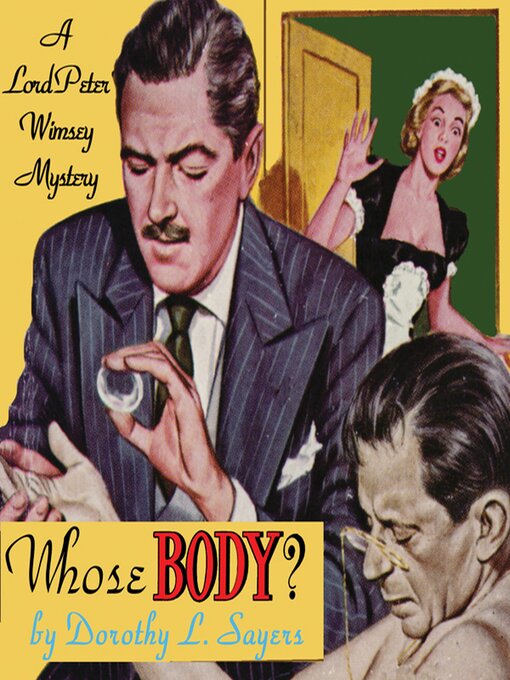
I'm just finishing Sayers's Whose Body? And yes, it really does have the question mark in the title, as you can see above.  Isn't this a really great, retro cover?  I have really enjoyed this book for a number of reasons.  I read one or two of Sayers's Lord Peter Wimsey mysteries some years ago, and I have seen two different actors portray Lord Peter, courtesy of the BBC.  But now, I've started at the beginning with Whose Body? and hope to read as much as I can of the series (in order, of course) over the next couple of weeks.  OK, so this book is set in England in the early 20s, I think--it was published in 1923.  And one thing that we discover about Lord Peter (a younger son, without land or a title) is that he suffers shell-shock.  I'm interested in how the World Wars affect English culture, and especially English cultural identity.  And--I don't know--I'm always interested in England between the wars, particularly.  But one really cool think about this novel is the ways in which the narrator keeps reminding us that it is, in fact, a novel, a work of fiction.  Over and over, Lord Peter makes remarks like, "well, if this were a Sherlock Holmes story, instead of real life. . . "  But of course, it's not real life and is much more akin to a Sherlock Holmes story.  Towards the end, the narrator tells us that Lord Peter, as an detective, albeit an amature one, has been affected by Holmes and other literary detectives.  And of course, Peter is, in a way, the literary offspring of Holmes.  Lord Peter himself is quite bookish and quotes poetry and that kind of thing a lot, which makes it all double fun!  I'm sure that Sayers's The Mind of the Maker would be instructive here, would allow one to make connections between literary creation and the real world, but I don't remember much about it all.  I'm sooooo enjoying Sayers, anyway.  She's a remarkable person; she was a scholar who, among other things, translated Dante's Divine Comedy, into verse, I think. (Lord Peter, by the way, purchases some rare edition of Dante and reads Dante in the novel.) And she's a really good writer--better, I'd say, than Agatha Christie, who writes during the same period and seems to be much more popular, at least now.  Anyway, I realize that this isn't so like super insightful  or super academic or anything.  But I'm just really enjoying this novel and am especially intrigued by the intertextual references and how they suggest we might read / interpret the work.  Oh, plus, the book opens with a man's finding a naked corpse, wearing only glasses, in his bathtub.  And it takes quite a while to decide whose body it is, hence Whose Body?  And really, that all by itself is great!

20 August 2008

I just went upstairs to photocopy syllabi, but the photocopier jammed, which isn't unusual, and I'm waiting for the staff to fix it.  This means that I have a bit of free time.  I've realized last night and this morning that I'm super excited for the semester to start in some ways.  I'm teaching a course that I'm calling British Detective Fiction, and it's just feeling super fab and fun and interesting.  And maybe this is why I have the job I do, because where else would I be getting paid to reading and talk about Sherlock Holmes and Inspector Morse and Albert Campion and Inspector Dalgliesh and all the rest?  Really, what could be better than that?  And I'm looking forward to all the little things, like rereading The Hound of the Baskervilles and, even better, watching all the adaptations I can get ahold of.  The one with Peter Cushing and Christopher Lee is the absolute worst / best.  It could qualify for MST3K, and if you are really interested, Netflix has a great trailer for it here, which gives a good sense of the tone and production quality of the whole thing.  And it just seems like there's so much to read and talk about and look forward to.  As I've been reading and thinking about this course, it's come to my attention that all these people I know, especially my colleagues, are sort of in the closet about reading murder mysteries, and it feels great to feel like there's actually this whole community of us indulging in this reading and that, I don't know, we don't have to keep being in the closet about it.  And I keep thinking about  mysteries and detectives and popular culture and official culture and medievalism.  And I keep watching more and more of the Midsommer Murders, which are grand, and plan to start at the beginning and watch all of the BBC's Inspector Morse, who is probably my favorite.  And it's nice--finally!--to feel interested in something again.

19 August 2008

Ok, so I haven't posted much lately--here's a quickie update.  I'm feeling less depressed / anxious, which is good.  I've been busy with prepping for the new semester--classes start Monday.  I always kinda enjoy getting all organized and putting together syllabi and planning out my semester, but it's always a little maddening too.  For example, yesterday, I discovered that three novels I'd planned to teach this fall are out of print.  That really hadn't occurred to me as a possibililty (silly me!) and wasn't an eventuality that I'd considered.  And it was just somehow so frustrating.  I mean, it seems especially ridiculous (or something) that in a series of detective novels, all but one would be available, especially when it's the one that everyone seems to think the best.  And yes, they can be purchased used online for really very reasonable prices.  But that sort of isn't the point.  I guess it was an unexpected bump in the road, or whatever.  And I've been working a lot--mental work, not physical labour--and I've been tired but not able to get to sleep.  And the whole insomnia thingy is always maddening in its own way.  And then, I've been really craving a good cheese burger, which is unlike me, mostly because I don't normally eat dead cow.  So I guess I just don't really know what's going on with me other than to say that I've been working a lot and I'm tired but I'm somehow satisfied.

15 August 2008

I don't know where to begin.  I've been back from CA for nine days now, and with each passing day, I've become increasingly blah feeling.  With the exception of yesterday, it's rained every day since I've been back.  And maybe that's part of my current listlessness.  About four days ago, I had several nights of wicked bad insomnia, and that affects my mood too.  And maybe it's just that I'm ready to go back to work; after all, it's been about three months since I've really worked.  The only other summer I've not taught was the summer I was working, nearly feverishly, to finish my dissertation.  And that counts as work, doesn't it?  I had grand plans, at one point, to get lots and lots of studying and prep and writing done over the summer, but somehow that didn't happen.  Until I left for CA, I did get lots of crafting and yoga and fun reading done, and it seems like that's really, really what I needed to do with my summer.  (And wow, when's the last time I wrote a "what I did with my summer vacation" essay?)  But now, on the other end of things, I feel icky, that whole I-haven't-accomplished-anything feeling, coupled with creeping anxiety, the paralyzing kind.  And apparently Netflix is having technical difficulties, so I don't have anything good to watch.  *sigh*  I'm just feeling kinda lonely and lost and purposeless.  Not good.  But starting next week, I'll just have to get a lot of work done, in anticipation of the new semester, and really, maybe that's good for me.  I'm looking forward to it.