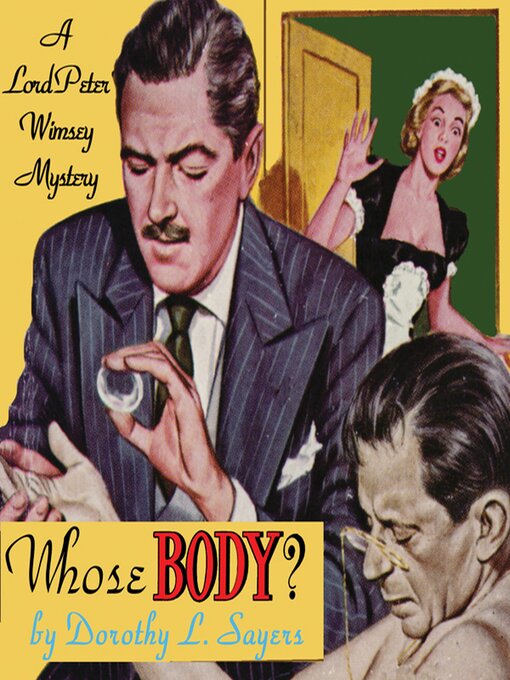
 I'm just finishing Sayers's Whose Body? And yes, it really does have the question mark in the title, as you can see above. Isn't this a really great, retro cover? I have really enjoyed this book for a number of reasons. I read one or two of Sayers's Lord Peter Wimsey mysteries some years ago, and I have seen two different actors portray Lord Peter, courtesy of the BBC. But now, I've started at the beginning with Whose Body? and hope to read as much as I can of the series (in order, of course) over the next couple of weeks. OK, so this book is set in England in the early 20s, I think--it was published in 1923. And one thing that we discover about Lord Peter (a younger son, without land or a title) is that he suffers shell-shock. I'm interested in how the World Wars affect English culture, and especially English cultural identity. And--I don't know--I'm always interested in England between the wars, particularly. But one really cool think about this novel is the ways in which the narrator keeps reminding us that it is, in fact, a novel, a work of fiction. Over and over, Lord Peter makes remarks like, "well, if this were a Sherlock Holmes story, instead of real life. . . " But of course, it's not real life and is much more akin to a Sherlock Holmes story. Towards the end, the narrator tells us that Lord Peter, as an detective, albeit an amature one, has been affected by Holmes and other literary detectives. And of course, Peter is, in a way, the literary offspring of Holmes. Lord Peter himself is quite bookish and quotes poetry and that kind of thing a lot, which makes it all double fun! I'm sure that Sayers's The Mind of the Maker would be instructive here, would allow one to make connections between literary creation and the real world, but I don't remember much about it all. I'm sooooo enjoying Sayers, anyway. She's a remarkable person; she was a scholar who, among other things, translated Dante's Divine Comedy, into verse, I think. (Lord Peter, by the way, purchases some rare edition of Dante and reads Dante in the novel.) And she's a really good writer--better, I'd say, than Agatha Christie, who writes during the same period and seems to be much more popular, at least now. Anyway, I realize that this isn't so like super insightful or super academic or anything. But I'm just really enjoying this novel and am especially intrigued by the intertextual references and how they suggest we might read / interpret the work. Oh, plus, the book opens with a man's finding a naked corpse, wearing only glasses, in his bathtub. And it takes quite a while to decide whose body it is, hence Whose Body? And really, that all by itself is great!


a president, a King
13 years ago


No comments:
Post a Comment